Two Universes
The Lore of Might and Magic is not one continuous story but two stories that share a brand name. This text also keeps them apart, exactly as they exist in the source material:
- Part I — The Ancient Universe
- Might and Magic role-playing games 1-9
- Heroes of Might and Magic strategy games 1-4
- Heroes Chronicles series bonus content
- Olden Era
- and more
- Part II — The Ashan Universe
- Heroes of Might and Magic V
- Might & Magic: Heroes VI and VII
- Might & Magic X: Legacy
- Dark Messiah of Might and Magic
- Clash of Heroes
- and more
Dating systems
- Ancient Universe: dates are counted from an event called The Silence — BS (“Before the Silence”) counts down toward zero, AS (“After the Silence”) counts up. Most games take place in the 1100s–1200s AS.
- Ashan Universe: dates are counted in YSD (“Years of the Seventh Dragon”), starting from the moment a mortal first ascended to dragonhood.
Part I – The Ancient Universe
The core cosmology has a few load-bearing pieces which are revealed as the story unfolds.
The Ancients. A god-like, technologically supreme civilization that colonizes developing worlds across the galaxy. They draw power from stars and build entire societies, then ship them off to cultivate new planets. Thus, to ordinary people on these worlds, the Ancients are myth and memories of artifacts from the Time of Wonders.
The Creators. A rival cosmic force, existing in a nebulous realm, who construct chaotic monster-armies to disrupt the Ancients’ colonies. Moreover, the Ancients-versus-Creators struggle remains the oldest conflict in the setting.
The Kreegan. A demonic, insectoid species from the Void whose biology forces them to breed until a world can no longer sustain them, then launch ships to conquer the next world and repeat. Additionally, they attacked the empire of the Ancients, severing the network of communication and shipping. Consequently, that collapse is known as, The Silence.
The Great Experiment. Remembered a thousand years later, as everyone’s ancestors arriving on a great ship across the void between the stars — refers to this experiment of distributed colonization.
Guardians. Androids built by the Ancients assigned by the Ancients to administer colonization efforts.
Might and Magic I: The Secret of the Ancients (1986)
The saga begins on VARN, a world that appears to be an ordinary fantasy wilderness. A party of adventurers explores the land, uncovering hints of a hidden intelligence behind the scenes and references to a mysterious figure named Corak who is hunting an even more mysterious villain named Sheltem. What looks like a standard gather clues and clear dungeons quest slowly peels back to reveal that the world itself is a mystery and that its troubles trace to a single corrupted overseer.
Gameplay Summary
| Party Size: | 6 |
| Exploration Style: | Grid-Based, without visible foes in game world. |
| Combat Style: | Turn-Based, all commands issued at each turn start and then resolution occurs in initiative order. |
| Magic System: | Spells are learned during the level-up process and that is the only way to learn spells. Hybrid caster classes are precluded from the highest level spells. |
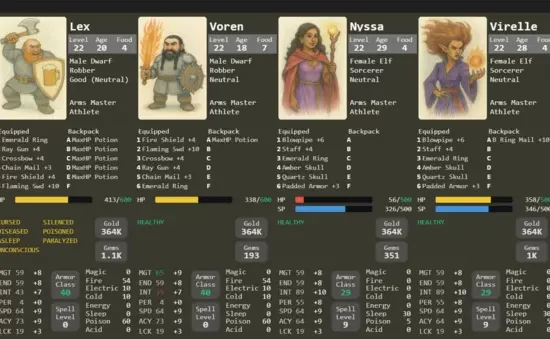
| Classes: | Knight, Robber, Cleric, Paladin(H), Sorcerer, Archer(H) |
| Races: | Human, Elf, Dwarf, Gnome, Half-Orc |
| Notes: | The game is difficult from the start and the player must get used to save often and die often as they make incremental progress developing their strength. Players must accept grinding experience from time to time before venturing forth to a new area. Clues are scattered all over the world, it is up to the player to discover and write down the clues without knowing if or when the clue will be helpful. There is no mapping function built into the game so manual mapping is highly encouraged. Some fan-based tools exist to assist with the mapping process. It is possible to transfer your party from Might and Magic I into Might and Magic II but this feature does not persist in the series any further. Learn More… |
Spoiler Revelations
Sheltem, the rogue Guardian, has crash-landed on VARN, deposed and replaced the real King Alamar, and is masquerading in his palace. The adventurers eventually unmask the impostor king as Sheltem and foil his machinations, but Sheltem escapes through a magic portal rather than being destroyed. The ending also breaks the fantasy frame: the party meets Corak and learns the true, science-fictional nature of their world.
Might and Magic II: Gates to Another World (1988)
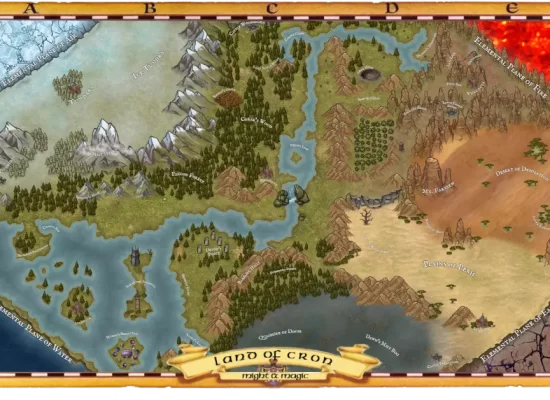
The chase continues on a new world, CRON. Sheltem has fled here and is once again working destruction from the shadows. This installment leans into time travel and cosmic scope, but the emotional engine is the same manhunt: Corak pursuing Sheltem, and the heroes caught between them.
Gameplay Summary
| Party Size: | 8, with a potential roster of 48 |
| Exploration Style: | Grid-Based, without visible foes in game world. |
| Combat Style: | Turn-Based, all commands issued at each turn start and then resolution occurs in initiative order. |
| Magic System: | Some spells are learned during the level-up process and some spells are found or purchased from a guild. Hybrid caster classes get spells slower than pure caster classes and are precluded from the highest level spells. |
| Classes: | Knight, Barbarian, Robber, Ninja, Cleric, Paladin(H), Sorcerer, Archer(H) |
| Races: | Human, Elf, Dwarf, Gnome, Half-Orc |
| Notes: | A lot of time grinding experience can be skipped if players import character from the previous game. A new party starting out in Might and Magic II will have a difficult start but it is very possible with perseverance and a similar Save and Retry flow as in the first game. This game features time travel which allows the same game world to be explored in multiple time periods. There are up to 24 hirelings that can be found and used as your own characters. This game features a Roster system where you can swap up to 48 characters into and out of your party over the course of the playthrough. Learn More… |
Spoiler Revelations
Sheltem has seized control of CRON and set it on a collision course with its sun, intending to incinerate the entire world. The adventurers manage to correct CRON’s course and save it — but, true to form, Sheltem slips away again before he can be captured. The “gates” of the title refer to the portals and time-gates that let both the villain and the heroes leap between worlds and eras, establishing that this saga is fought across space and time.
Might and Magic III: Isles of Terra (1991)
The hunt reaches Terra, the world where everything started and the planet Sheltem was originally built to guard. This is the game that most explicitly spells out the setting is science fiction. The game describes the Ancients (who “draw their power from the heat and light of stars”) and the Creators (who “construct their plots… to disrupt the civilizations of the Ancients”). It frames the whole colonization effort as “The Great Experiment.”
Gameplay Summary
| Party Size: | 8, 6 custom plus 2 of 10 potential hirelings. |
| Exploration Style: | Grid-Based, with visible foes in the game world. |
| Combat Style: | Turn-Based with real-time engagement presenting the opportunity to fire ranged attacks and spells at foes prior to turn-based combat. Once fully engaged, turn-based combat ensues and all commands are issued at each turn start and then resolution occurs in initiative order. |
| Magic System: | Spells are not learned during the level-up process at all. Spells are found or purchased from a guild. Hybrid caster classes are not precluded from higher level spells anymore but they will pay more gold to buy any spell. The Druid spellbook is new but it contains a mix of Cleric and Sorcerer spells with no unique spells. |
| Classes: | Knight, Barbarian, Robber, Ninja, Cleric, Paladin(H), Sorcerer, Archer(H), Druid, Ranger(H) |
| Races: | Human, Elf, Dwarf, Gnome, Half-Orc |
| Notes: | This game features an expansive list of items and various modifiers that may randomly appear on found items. This game also leans into the concept of temporary boosts found in the game world which encourages the player to return often and boost up before facing difficult challenges. This game no longer has “random encounters” like the previous games, now there is a semi-finite amount of foes in the game world with an introduction of foe generator spawn points that can be destroyed. Learn More… |
Spoiler Revelations
The heroes disrupt Sheltem’s scheme on Terra and drive him off course once more. This time Sheltem flees in a space shuttle; Corak pursues in a second shuttle; and the party of adventurers follows in a third. Sheltem lands safely on a new world, XEEN, setting the stage for the two-part finale.
Might and Magic IV: Clouds of Xeen (1992)
The world of Xeen is described as a flat world with two sides. Clouds of Xeen takes place on the sunlit upper surface of Xeen. A tyrant, name Lord Xeen rules through fear, and the adventurers are drawn into liberating the inhabitants.
Gameplay Summary
| Party Size: | 6 total and no hirelings |
| Exploration Style: | Grid-Based, with visible foes in the game world. |
| Combat Style: | Turn-Based with real-time engagement presenting the opportunity to fire ranged attacks and spells at foes prior to turn-based combat. Once fully engaged, turn-based combat ensues and all commands are issued at each turn start and then resolution occurs in initiative order. |
| Magic System: | Spells are not learned during the level-up process at all. Spells are found or purchased from a guild. Hybrid caster classes are not precluded from higher level spells but they will pay more gold to buy any spell. |
| Classes: | Knight, Barbarian, Robber, Ninja, Cleric, Paladin(H), Sorcerer, Archer(H), Druid, Ranger(H) |
| Races: | Human, Elf, Dwarf, Gnome, Half-Orc |
| Notes: | This game features a difficulty setting where the harder option is typical of the series to date and the easier option was added to make the game more accessible. On the cloud-side of the world each zone has a surface and also an explorable area in the clouds, effectively doubling the area to explore with the same number of map regions – plus a vast number of dungeons, towers, and caves. Learn More… |
Spoiler Revelations
Sheltem and Corak both crashed on Xeen. Corak is trapped inside his ship; Sheltem is free. Sheltem installs Lord Xeen — to enslave the cloudside of Xeen. The heroes will find clues that a darkside exists and that Lord Xeen is a puppet.
Might and Magic V: Darkside of Xeen (1993)
Darkside of Xeen takes place on the darker under surface of the world. Sheltem is behind Lord Xeen’s actions on the cloudside and plots to destroy the world, yet again. The party must help Corak confront Sheltem in a grand climax.
Gameplay Summary
| Party Size: | 6 total and no hirelings |
| Exploration Style: | Grid-Based, with visible foes in the game world. |
| Combat Style: | Turn-Based with real-time engagement presenting the opportunity to fire ranged attacks and spells at foes prior to turn-based combat. Once fully engaged, turn-based combat ensues and all commands are issued at each turn start and then resolution occurs in initiative order. |
| Magic System: | Spells are not learned during the level-up process at all. Spells are found or purchased from a guild. Hybrid caster classes are not precluded from higher level spells but they will pay more gold to buy any spell. |
| Classes: | Knight, Barbarian, Robber, Ninja, Cleric, Paladin(H), Sorcerer, Archer(H), Druid, Ranger(H) |
| Races: | Human, Elf, Dwarf, Gnome, Half-Orc |
| Notes: | This game is nearly identical to Clouds of Xeen from a mechanical perspective but there are new foes and many new areas to explore. You will even find keys that allow you to explore a few previously locked dungeons and towers on the cloudside. Players can play Clouds and then Darkside in succession or they can play them both at the same time after installing both on the system. Note that Clouds is more difficult if played in isolation as the Darkside experience is not available. Learn More… |
Spoiler Revelations
In the combined world of Xeen climax, Corak confronts Sheltem at last, seizes him, and triggers his own self-destruct mechanism, destroying both Guardians together. This ends the original saga: the villain who eluded the heroes across five games and four worlds is finally stopped, at the cost of his lifelong pursuer. The Unification Ceremony is completed which transforms the dual-sided flat nacelle into a spherical world.
Heroes of Might and Magic: Olden Era (2026)
The franchise’s modern revival is, surprisingly, a return to the original Enroth continuity rather than the Ashan reboot. Olden Era is a prequel to the very first Heroes of Might and Magic (A Strategic Quest), set on the continent of Jadame on the planet Enroth. It depicts an era before the Ironfist dynasty, when rival factions must set aside their feuds to face a common horror.
Spoiler Revelations
The central threat is the Hive — a swarm of insectoids corrupted by a demon lord called the Dragonfly King. Thematically this ties into the old universe’s demonic-insectoid lineage (the same conceptual family as the Kreegan), and the game’s drama comes from rival powers forging fragile alliances to survive it.
Heroes of Might and Magic: A Strategic Quest (1995)
The strategy series opens with an exile’s story. Lord Morglin Ironfist, cheated out of his rightful throne in his homeland, flees through a magic portal with a few loyal followers and emerges on the continent of Enroth, which is fractured by a four-way civil war. To survive, he must conquer the land — and in doing so, he founds the Ironfist dynasty that anchors the entire continuity.
Spoiler Revelations
Morglin’s flight is a family tragedy: his uncle murdered his father (the rightful ruler), and his cousin Ragnar usurped the throne, forcing Morglin to escape to a different planet. On Enroth he finds three rival warlords already at war — Lord Slayer, Queen Lamanda, and Lord Alamar. The canonical outcome is Morglin’s total victory: he defeats all rivals, unites Enroth under his rule, and establishes the Kingdom of Enroth and Castle Ironfist. Every later Ironfist — Roland, Archibald, and Catherine’s children — descends from this moment.
Heroes of Might and Magic II: The Succession Wars (1996)
A generation later, Morglin is dead, and Enroth is torn apart by the question of who inherits his crown. His two sons — noble, sun-aligned Roland and ambitious, darker Archibald — go to war. The player picks a side, but the canonical history records a definite winner whose victory sets up everything in Might and Magic VI and VII.
Spoiler Revelations
Archibald schemes and murders his way to the throne first, becoming King of Enroth, but a rebellion forms around Roland — backed by figures who reappear throughout the series, including Lord Haart, Erik von Stromgard, Anthony Stone, and Albert Newton. Roland wins; Archibald is defeated and literally turned to stone, remaining a petrified prisoner for years. Roland assumes the throne and soon marries Catherine Gryphonheart of Erathia, uniting the two great dynasties. This is the marriage and reign that Might and Magic VI depends on.
Might and Magic VI: The Mandate of Heaven (1998)
A new saga begins, Might and Magic VI is set on the continent of Enroth and shares its world and timeline with the Heroes of Might and Magic strategy games. The land is reeling from a catastrophe called the Night of Shooting Stars. King Roland Ironfist and Queen Catherine rule Enroth and the Cult of Baa spreads across the land with cheap temple services while the kingdom teeters. Four Heroes are sponsored by the crown to restore order.
Gameplay Summary
| Party Size: | 4 total and up 2 hirelings but the hirelings are not fully functional characters |
| Exploration Style: | 3D World with fluid movement |
| Combat Style: | Turn-Based or Real-Time hot toggle-able |
| Magic System: | Spell access based on Skill mastery. Spells are purchased or found. |
| Skill System: | Skill access is restricted by Class. Skills are learned at character creation or purchased. Skill mastery based on level-up point system and then purchased from the right trainer. If a class has access to a skill then they also have access to ALL mastery levels: Novice, Expert, Master. This is why an Archer can cast Lloyd’s Beacon, for example. |
| Classes: | Knight, Paladin, Archer, Cleric, Druid, Sorcerer are the basic classes and each can be promoted two a new class twice. |
| Races: | There are no races. |
| Notes: | The character development process in this game is completely different from the previous games. The spell systems and skill systems are completely new. Many people familiar with this game franchise started here. Learn More… |
Spoiler Revelations
The Kreegan have arrived and they disguised their invasion as a meteor shower. Over the course of the game Roland is captured by the Kreegan (he stays a prisoner for years — his rescue is a major plot thread in later games). The heroes restore the ancient Guardian construct Melian, purge the Cult of Baa, defeat sorcerers Agar and Ethric the Mad, and ultimately destroy the Kreegan Hive-Ship using the Ritual of the Void, sealing that wave of the invasion. The Kreegan queen and her lieutenants are slain. The title’s Mandate of Heaven refers to earning the legitimacy — and the ancient technology — needed to restore order.
Heroes of Might and Magic III: The Restoration of Erathia (1999)
Heroes III shifts the spotlight to the southern continent of Antagarich and the Gryphonheart dynasty. Queen Catherine Gryphonheart — now Catherine Ironfist — returns to her homeland of Erathia to find it invaded and her father murdered. The campaign is her war to “restore” the kingdom, drawing in necromancers, dungeon overlords, elves, and demons in a sprawling continental conflict.
Spoiler Revelations
The trigger is the assassination of Catherine’s father, King Nicolas Gryphonheart, by the traitor Lord Haart, which throws Erathia open to invasion by the subterranean Nighon dungeon-lords and the necromancers of Deyja. The master schemer behind much of the chaos is the necromancer Sandro, who manipulates events from the shadows; a major twist is that the necromancers reanimate the dead King Nicolas as an undead puppet. Catherine, aided by heroes such as Gelu, Crag Hack, Gem, and Yog, liberates the capital Steadwick and defeats the alliance. The expansions continue the arc: Armageddon’s Blade culminates in the forging of the titular world-threatening sword and the final defeat of the Kreegan king Lucifer Kreegan by the elf-hero Gelu; The Shadow of Death is a prequel detailing Sandro’s rise and schemes.
Note that Heroes III expansion The Shadow of Death specifically occurs BEFORE The Mandate of Heaven.
Note that Heroes III expansion Armageddon’s Blade specifically occurs AFTER For Blood and Honor.
Might and Magic VII: For Blood and Honor (1999)
The action moves to the continent of Antagarich (the same continent as Heroes of Might and Magic III). A party of adventurers inherits a rundown castle, Harmondale, a disputed border property caught between the human kingdom of Erathia and the elven kingdom of Avlee. From that small beginning the heroes are pulled into continental politics, an ancient buried starship, and a branching moral choice that lets the player align with the forces of Light or the forces of Dark.
Gameplay Summary
| Party Size: | 4 total and up 2 hirelings but the hirelings are not fully functional characters |
| Exploration Style: | 3D World with fluid movement |
| Combat Style: | Turn-Based or Real-Time hot toggle-able |
| Magic System: | Spell access based on Skill mastery. Spells are purchased or found. |
| Skill System: | Skill mastery is restricted by Class. Skills are learned at character creation or purchased. Skill mastery based on level-up point system and then purchased from the right trainer. |
| Classes: | Knight, Paladin, Archer, Cleric, Druid, Sorcerer are the basic classes and each can be promoted two a new class twice. |
| Races: | Human, Elf, Dwarf, Goblin |
| Notes: | This game is a lot like the previous games with these restrictive differences. Now there is a 4th tier of skill mastery: Novice, Expert, Master, Grandmaster.. and a given Class may have access to the skill but not have access to high tier. This is why an Archer can no longer cast Lloyd’s Beacon for example. Additionally different, this game features a Light and Dark choice. If you chose Light then your party may access the Light Magic school but you will be blocked from the Dark Magic school.. or the reverse. Learn More… |
Spoiler Revelations
Investigating their new land, the heroes uncover a crashed vessel, the Lincoln, carrying “Terrans” — visitors connected to the old Sheltem/Corak saga and the search for the Ancients. The Light/Dark choice determines which endgame the party pursues. A central thread is the rescue of King Roland Ironfist, still a Kreegan prisoner, and the disgraced former king Archibald Ironfist, Roland’s brother. The heroes also slay the Kreegan monarch Xenofex, effectively ending the Kreegan threat.
Might and Magic VIII: Day of the Destroyer (2000)
This chapter unfolds on the continent of Jadame, which is being torn apart by an elemental cataclysm. A being called The Destroyer has arrived, summoned a colossal crystal, and unleashed storms of raw elemental fury across the land. The party must unite various clans of the continent to save the land.
Gameplay Summary
| Party Size: | 1 character created, party size is up to 5 at one time. There are 35 hirelings to find in the world. |
| Exploration Style: | 3D World with fluid movment |
| Combat Style: | Turn-Based or Real-Time hot toggle-able |
| Magic System: | Spell access based on Skill mastery. Spells are purchased or found. |
| Skill System: | Skill mastery is restricted by Class. Skills are learned at character creation or purchased. Skill mastery based on level-up point system and then purchased from the right trainer. |
| Classes: | Knight, Troll, Minotaur, Cleric, Necromancer, Dark Elf, Vampire, and Dragon are the basic classes and each can be promoted to 1 new class. Note in the packaged game, you cannot create a Dragon character but you can find Dragon hirelings. |
| Races: | There are no distinct races but class list contains race-like distinctions. |
| Notes: | This game features a roster system similar to MM2 so you can swap hirelings in and out of your party over the course of a playthrough. Some of the classes come with spell-like skills. This game also has a choice but this time it is to ally with a particular factions, after making the choice the game will proceed to conclusion in a different way. This game is largely considered the easiest in the whole series as the power balance is heavily in the player favor from start to finish. Learn More… |
Spoiler Revelations
The Destroyer is Escaton, an agent of the Ancients. Escaton was dispatched with a chilling mandate: destroy the entire planet of Enroth to prevent the Kreegan infestation from spreading further across the galaxy. The Hero of Jadame confronts Escaton in the Plane Between Planes and points out that the Kreegan have already been wiped out, so the planet no longer needs to die — but Escaton’s programming will not let him abort his mission. The resolution involves freeing the captive Elemental Lords, whose imprisonment was powering the world-ending crystal storm, and thereby stopping the destruction.
Heroes of Might and Magic IV (2002)
Heroes IV is the hinge on which the entire Ancient Universe turns — because it opens with the end of the world. The old world of Enroth is destroyed, and the survivors flee to a brand-new world, Axeoth. The game’s six campaigns each tell how a different refugee kingdom was founded on Axeoth in the aftermath, making it an anthology of new beginnings rather than a single hero’s tale.
Spoiler Revelations
The apocalypse is called The Reckoning. It is caused by two ultimate weapons colliding in battle: Armageddon’s Blade (wielded by the elf Gelu) and the Sword of Frost (wielded by the barbarian king Kilgor). Their clash releases catastrophic energy that shatters Enroth, killing thousands and driving refugees through emergency portals to Axeoth. On the new world, the campaigns follow founders such as the knight Lysander (who discovers he carries Gryphonheart blood), the immortal wizard Gavin Magnus, the necromancer Gauldoth Half-Dead, and others building kingdoms like Palaedra, Great Arcan, and Nekross from the ashes.
Might and Magic IX (2002)
The final numbered RPG of the Ancient Universe is set on a different world — the continent of Rysh, in a land called Chedian — after the old world of Enroth has been left behind. It is a story of six warring clans and a land rebuilding after a great disaster known as the Great Cataclysm, dated to the years following its cause, a sorcerer named Verhoffin.
Gameplay Summary
| Party Size: | 4 total and up 2 hirelings but the hirelings are not fully functional characters |
| Exploration Style: | 3D World with fluid movement |
| Combat Style: | Turn-Based or Real-Time hot toggle-able |
| Magic System: | There are 4 magic Skills and spell access is gated behind a combination of magic skill mastery. |
| Skill System: | Skill mastery is restricted by Class. Skills are learned at character creation or purchased. Skill mastery based on level-up point system and then purchased from the right trainer. |
| Classes: | There are 2 starting classes [Fighter, Initiate] and through a hierarchical promotion structure may become 1 of 8 final classes. Gladiator, Assassin, Paladin, Ranger, Priest, Druid, Mage, Lich. |
| Races: | Human, Dwarf, Elf, Half-Orc |
| Notes: | This game is not like the rest though the skill system is recognizable. This game was rushed and there are some bugs to contend with along with a host of foes. The bugs can be considered remnants of the Great Cataclysm. Learn More… |
Spoiler Revelations
Continuity is deliberately thin where only one character from earlier games returns in person — Prince Nicolai Ironfist, son of Roland and Catherine. King Roland and the Kreegan are mentioned in passing. The Great Cataclysm and the sorcerer Verhoffin connect loosely to the wider post-apocalyptic world of Axeoth that the Heroes IV storyline established. This game was rushed to market and is largely considered incomplete and buggy.
Heroes Chronicles – The Tarnum Saga (1999-2001)
Heroes Chronicles is a series of short, standalone strategy campaigns using the Heroes III engine, all built around one immortal protagonist: Tarnum, the “Immortal Hero.” Once a tyrannical Barbarian King, Tarnum is denied both death and paradise and instead condemned by his ancestors to wander history, repeatedly redeeming himself by fighting for good causes across the ages. Because he is effectively deathless, the episodes span centuries and fill in huge stretches of the Ancient Universe’s backstory.
Spoiler Revelations
The episodes (Warlords of the Wasteland, Conquest of the Underworld, Masters of the Elements, Clash of the Dragons, The World Tree, The Fiery Moon, Revolt of the Beastmasters, The Sword of Frost) each drop Tarnum into a different crisis: liberating slaves to found the nation of Tatalia, repelling the Elemental Lords, recovering a dead king’s soul from the underworld, and more. The saga’s final episode, The Sword of Frost, is pivotal to the whole continuity: it is the story of the race to claim the Sword of Frost, one of the two weapons whose eventual clash causes The Reckoning that destroys Enroth in Heroes IV. Tarnum’s arc ends with him finally earning peace after lifetimes of penance.
Crusaders of Might and Magic (1999)
A 3D action game following a warrior named Drake battling a dark army. In the PSX version, the story connects to the wider Might and Magic cosmology through deep background: an ancient, buried alien technology tied to the Kreegan.
Spoiler Revelations
In the PSX finale, Drake fights to Celestia’s empty throne room, then finds a hidden chamber full of arcane, futuristic machinery, and an elevator leading to an outer-world location. There stands Necros before an enormous inter-dimensional portal: the Kreegan Gate. Necros taunts Drake, claiming Celestia coveted the Kreegans’ power just as much as he did. Rather than fight the invincible necromancer, Drake destroys the Gate itself.
Warriors of Might and Magic (2000)
A 3D action game for consoles loosely tied to the world, largely self-contained.
Spoiler Revelations
Nothing to see here, no major updates to the Lore overall. At worst, this feels like a cash-grab using the “Might and Magic” brand. At best, it is an attempt to save the franchise by pulling new players from new markets.
Shifters of Might and Magic (2002)
A 3D action game for PS2 loosely tied to the world, largely self-contained.
Spoiler Revelations
Nothing to see here, no major updates to the Lore overall. At worst, this feels like a cash-grab using the “Might and Magic” brand. At best, it is an attempt to save the franchise by pulling new players from new markets.
Legends of Might and Magic (2001)
A multiplayer first-person shooter set in the universe; almost no bearing on the main storyline.
Spoiler Revelations
Nothing to see here, no major updates to the Lore overall. At worst, this feels like a cash-grab using the “Might and Magic” brand. At best, it is an attempt to save the franchise by pulling new players from new markets.
Part II – The Ashan Universe
After New World Computing and 3DO collapsed, Ubisoft bought the franchise and rebooted it from scratch in 2006. Out went the science fiction — no Ancients, no colony ships, no Kreegan, no Sheltem. In came Ashan, a pure high-fantasy world with a dragon-god cosmology.
Asha and Urgash — the primordial twin dragons. From a cosmic egg hatched two opposite forces: Asha, the Dragon of Order, who lovingly created the world; and Urgash, the Dragon of Chaos, her destructive twin. Their war ends the mythic age with Urgash defeated (not destroyed) and imprisoned in the world’s fiery core.
The six Elemental Dragons. Asha bore six dragon-children, each embodying a “color” of magic and each the patron of an Elder Race:
- Elrath — Light — patron of the Angels
- Malassa — Darkness — patron of the Faceless
- Sylanna — Earth — patron of the Elves
- Arkath — Fire — patron of the Dwarves
- Shalassa — Water — patron of the Nagas
- Ylath — Air — patron of the Humans
The Demons. From Urgash’s chaotic nature sprang the Demons, imprisoned in a fiery prison-dimension called Sheogh inside the world. Their recurring escapes — always during a lunar eclipse (“Blood Moon”), which weakens Sheogh’s walls — drive most of Ashan’s history. These “Eclipses” are the setting’s recurring apocalypse and the way the timeline is chapter-based.
The Seventh Dragon. A mortal (the star-elf mage Sar-Elam) who achieved enlightenment and ascended to become a seventh dragon — the “Dragon of Spirit.” His self-sacrifice locked the demons away and defined Year 0 (YSD). His followers became the secretive Dragon Knights.
The factions you’ll actually play map onto the Elder Races and their offshoots: the Haven (human knights of the Holy Empire, worshipers of Elrath/Light), Sylvan (elves), Academy (human wizards of the Silver Cities), Dungeon (Dark Elves, worshipers of Malassa), Necropolis (necromancers who venerate Asha’s aspect of death via “Mother Namtaru”), Inferno (demons), Fortress (dwarves), and Stronghold (orcs — created by wizards mixing demon blood with human stock to fight the demons).
Foundational Backstory: The “Made” Races and the Necromancer Schism
(These events are deep history — they predate every playable game, so they are not the plot of any single title. They are established in the world’s background lore and surface through the Academy, Stronghold, and Necropolis faction storylines across the games. Chronologically they sit in and just after the First Eclipse, centuries before Heroes VI, the earliest mainline game at 564 YSD.)
The orcs and beastmen — the demon-blooded races. During the First Eclipse — the demon invasion known as the War of the Blood Moon, around the 330s YSD — the human wizards of the Seven Cities were losing. In desperation, the Crimson Wizards of House Chimera infused human slaves and criminals with demon blood, engineering the Orcs as shock troops. The gamble worked: the orcs turned the tide and saved Ashan. Later, in 512 YSD, House Chimera created the Beastmen (minotaurs, centaurs, harpies, rakshasas), partly to replace the orcs. But both races were kept enslaved even after their service, and both eventually revolted and won their freedom — the orcs largely fleeing to the Pao Islands. House Chimera was blamed for loosing demon-tainted creations on the world and lost enormous influence. This origin is why the Stronghold (orc) faction exists at all, and why it remains permanently estranged from the wizard-run Academy.
The necromancers — House Eterna and Mother Namtaru. In 461 YSD, the mage Belketh, a student of the seer Sar-Shazzar, invented necromancy and founded House Eterna within the Seven Cities; its first undead were pressed into service to suppress the orc and beastmen revolts and to fight demons. Everything changed with the discovery of the Mother Namtaru, the avatar of Death — after which House Eterna drifted from a school of magic into a religious cult venerating the “Spider Goddess.” Crucially, this is not the worship of a god outside the dragon pantheon: Belketh’s doctrine holds that the Namtaru embodies Asha’s own third aspect, the Face of the Crone, who ends lives and fulfills destinies — so necromancers consider themselves Asha’s truest servants, not idolaters of a foreign deity. The other wizard houses disagreed, feared their growing power, and moved to purge them, igniting a long civil war that the necromancers lost (roughly 610–771 YSD). The survivors fled east and regrouped in Heresh, which became the Necropolis homeland.
Might & Magic: Heroes VI (2011)
Despite being the sixth Heroes game by release, Heroes VI is a deep prequel, set roughly four centuries before Heroes V. It tells the saga of the Griffin dynasty at a moment of crisis: the assassination of a beloved duke throws his five children onto diverging paths — each pledged, by circumstance, to a different faction — while a demon invasion looms and an ancient angelic conspiracy stirs beneath the surface.
Danse Macabre DLC (2012) has Sandro as the protagonist, sets out to reclaim his lost Staff of the Netherworld — held in the private collection of Duke Ovidio of the Bull. This occurs AFTER heroes VI main story.
Shades of Darkness DLC (2013) has Sandro as the villain and the player are cast as the necromancer, Vein, who must stop Sandro from destroying Mother Namtaru.
Spoiler Revelations
The murdered patriarch is Duke Slava Griffin; his five children each align with a different faction — Anton (Haven), Anastasya (Necropolis), Kiril (Inferno), Sandor (Stronghold), and Irina (Sanctuary/Naga) — giving the game a family-saga structure. The hidden antagonist is a legendary Archangel general, Uriel (killed long ago in the ancient Elder Wars and secretly resurrected), who feared Duke Slava would one day defy the Angels and so engineered his death — magically compelling the daughter Anastasya to kill her own father — in order to install the more “malleable” Anton and, under cover of the coming demon invasion, recover his power and seize control of Ashan. The siblings ultimately reunite to expose Uriel and avenge Slava; the framed Anastasya is raised into undeath, a thread that reverberates through the family. Iconic old-series names such as Sandro, Crag Hack, and Yog appear only as references on artifacts and achievements — nods to the old universe, not the same characters.
Every Dog Has His Day is a Stronghold campaign starring Dogwoggle, one of mad King Kilgor’s barbarian generals, with Chief Tarnum available as a joining hero (at level 50).
Might & Magic: Heroes VII (2015)
The most recent mainline strategy entry frames its story as a council of advisors telling history to a duke facing a civil war. Duke Ivan Griffin convenes a Shadow Council of six representatives — each recounting a tale from a different faction’s perspective — as he decides how to win the throne during a brutal war of succession called the Ten Years War.
Spoiler Revelations
The framing is set during the succession crisis that follows the collapse of the old Falcon line: with Empress Maeve Falcon dead (murdered during the demon-driven Fourth Eclipse of 843 YSD), every duchy has a blood-claim, and the realm fractures into ten years of civil war. Ivan Griffin is put forward as the wisest candidate but must defeat the rival Duke Seamus Stag, whose line was historically the heir apparent. Ivan defeats Seamus at the Battle of Horncrest, imprisoning him and ending the Ten Years War, and is crowned, founding the reformed Holy Griffin Empire — the very empire that, centuries later, Isabel rules in Heroes V. The six council stories fill in surrounding lore (an elf’s tale, a necromancer’s tale, and so on), several of which touch the fate of the Blade artifacts and the ongoing demon threat.
The Every Dog Has His Day campaign was built from scripts by Terry Ray that were originally written for Heroes IV and cut before release. So it’s genuinely leftover Heroes IV material finally finished and bolted onto an Ashan-era game. It even ties into the pre-Reckoning plot: Dogwoggle turns double-agent against the mad Kilgor and cuts a deal with Erathia to steal the Sword of Frost and swap in a copy — the very weapon whose eventual clash causes the Reckoning. In short: an old-universe (Enroth/Axeoth) tale wearing a Heroes VII wrapper.
Might & Magic: Clash of Heroes (2009)
Released as a puzzle/RPG hybrid, Clash of Heroes follows five young heroes — one from each of five factions — whose lives are shattered by a demonic plot during a fragile peace. Their coming-of-age stories converge into a single campaign to stop a hidden Demon Lord about four decades before the Heroes V generation. You will meet Merkal which again appears in Heroes V. You will also see the end of Ludmilla who you may remember from Heroes VI.
Spoiler Revelations
The five protagonists are Godric (knights/Haven), Aidan (demons/Inferno), Anwen (elves/Sylvan), Nadia (wizards/Academy), and Fiona (necromancers/Necropolis). They begin as “five lost children” whose homes and families are destroyed by a scheming Demon Lord. The villain is Azh Rafir, a demon lord who is revealed to be Nadia’s own father, and who is manipulating a powerful artifact, the Blade of Binding — an object that could open a portal to the demon realm and unleash full-scale war on Ashan. In the climax, a heartbroken Nadia confronts and defeats Azh Rafir in his true demon form, then destroys the Blade of Binding to derail his plan and restore peace to Ashan. The young knight Godric later grows into a major supporting figure in Heroes V.
Heroes of Might and Magic V (2006)
The flagship of the reboot. Heroes V opens on a wedding that becomes a war: as King Nicolai of the Holy Griffin Empire marries the Lady Isabel, a sudden demon invasion from Sheogh shatters the celebration and plunges the human empire into a desperate war. Isabel becomes the central figure, hunting for her lost king and rallying elves, wizards, and even unlikely allies against the demon lords.
Agrael, a demon lord and the hero of the Inferno campaign — the very demon who mortally wounds King Nicolai at the start of the game. He’s marked by prophecy and, unusually for a demon, has a conscience and a slow redemptive arc.
Spoiler Revelations
Early on, King Nicolai Griffin is mortally wounded by the demon lord Agrael, and Isabel becomes the driving protagonist, searching for a way to save or avenge him. The demon lord Agrael has his own arc of doubt and redemption. The great twist: Isabel’s trusted lady-in-waiting, Beatrice, is secretly Biara, a shapeshifting succubus serving the demon overlord Kha-Beleth — and, by the expansions, “Queen Isabel” herself is replaced by Biara wearing her face. It is revealed that Isabel was marked at birth to be a pawn in Kha-Beleth’s grand scheme: to sire the prophesied Demon Messiah. In the climax of the expansions (Hammers of Fate, Tribes of the East), the real Isabel returns to slay her impostor; disillusioned, she abdicates, hands her crown to her ally Freyda, dissolves the Griffin Empire, and founds the Holy Unicorn Empire. Isabel is also established as the future mother of the Dark Messiah.
meanwhile… Agrael turns out to be only a pseudonym used during his service to demon-kind. His true identity is Raelag, a Dark Elf warlock — one of Tuidhana’s three sons and heir to her throne, among the first elves to forsake the Earth-dragon Sylanna, deal with the Faceless, and worship the Darkness-dragon Malassa (i.e., become Dark Elves). He breaks free of demonic influence, takes up the Dungeon/Dark Elf mantle, and becomes Isabel’s ally and love interest — the real Isabel retreats with him to the Dark Elf underground realm of Ygg-Chall while her impostor rules above.
Might & Magic X: Legacy (2014)
The reboot’s only numbered role-playing game — a deliberate throwback to the old grid-based, party-of-four first-person dungeon crawlers, but set in Ashan. A party of four adventurers arrive in the Agyn Peninsula region and is drawn into a struggle over succession, ancient artifacts, and the legacy of the Falcon dynasty.
Spoiler Revelations
The base campaign centers on the Agyn Peninsula and its city of Karthal, entangling the Raiders in local politics, orc raiders, naga intrigue, and the machinations of a powerful archmage. The expansion, The Falcon & The Unicorn, tells of Duke Oswin Unicorn’s attempt to overthrow Empress Gwendolyn Falcon and seize the empire; the party — aided by Rosalie and Lord Kilburn — works to stop his coup. The game’s deeper lore threads connect to Sar-Elam (the Seventh Dragon) and the ancient Falcon Empire, tying the party’s adventure back to the founding myths of Ashan.
Dark Messiah of Might and Magic (2006)
A complete genre departure: Dark Messiah is a first-person action-RPG. You play Sareth, a young man trained in magic and swordplay, sent by his master to recover a dangerous artifact, the Skull of Shadows. What begins as a fetch-quest becomes a journey into Sareth’s own monstrous heritage and the fate of demon kind. It is placed last here because its central prophecy — the arrival of the Demon Messiah — reaches its decisive moment at the tail end of the Heroes V era.
Spoiler Revelations
Sareth is dispatched by his mentor Phenrig to find the Skull of Shadows, aided by the wizard Menelag and his niece/apprentice Leanna, and accompanied by a mysterious, seductive spirit-companion, Xana. The apparent antagonist is the necromancer Arantir, who seems to be pursuing an evil plan. The central twist flips the whole story: Sareth himself is the prophesied Dark Messiah — the son of Queen Isabel (from Heroes V) and the Demon Sovereign Kha-Beleth. Arantir was actually trying to stop the prophecy, not enact evil. Sareth’s “companion” Xana and mentor Phenrig are agents of Kha-Beleth, who wants his son to embrace his demonic destiny and free demon kind. The ending branches on the player’s choice: Sareth can embrace or reject his father and his demonic nature, deciding the fate of Ashan.
Might & Magic Heroes Online (2014)
A browser-based Heroes-style game set in Ashan.
Might & Magic: Elemental Guardians (2018)
A mobile monster-collecting RPG loosely tied to the lore.
Might & Magic: Era of Chaos (2019)
A mobile strategy/auto-battler loosely tied to the lore.
Might & Magic: Chess Royal
It was a free-to-play real-time multiplyer auto-battler.